
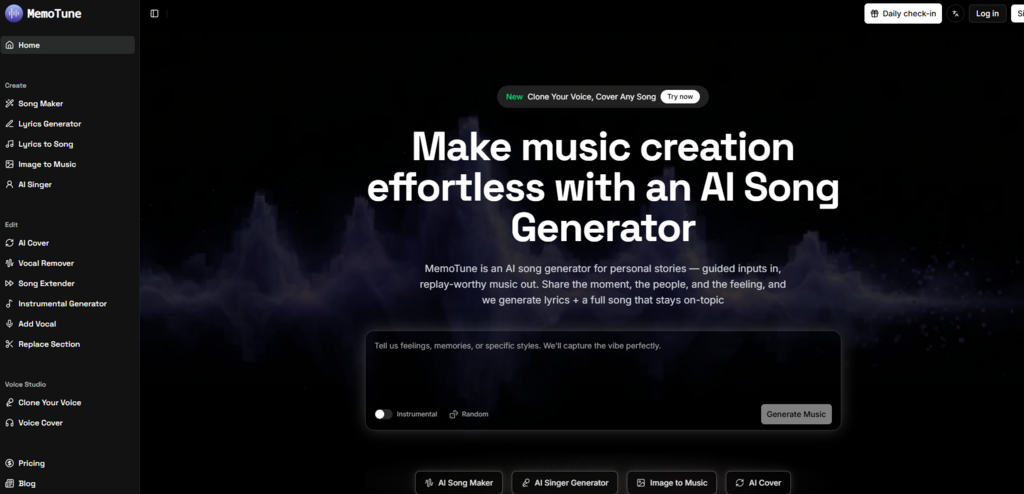
The new wave of AI music tools is not really about replacing musicians; it is about shortening the distance between a rough idea and something you can actually hear. That difference matters for lyric writers, video creators, indie marketers, and people who have a personal story but no production background. In that context, Ai Song Maker feels less like a novelty generator and more like a practical drafting room for songs.
I looked at MemoTune from the perspective of a user who already has an idea but does not know how to arrange it into music. That is a different test from asking whether the platform can impress someone with a random prompt. The more useful question is whether it helps a real person move from scattered words, emotional direction, or unfinished lyrics toward a complete song-shaped result.
MemoTune’s official workflow is built around that middle stage. The user can start with a prompt or lyrics, guide the style and mood, generate a song, listen back, and refine the result. That makes it especially interesting for people who do not need a full studio environment but still want more direction than a one-button music toy.
Why The Blank Page Is The Real Problem
Most music ideas fail before production even begins. A person may have a chorus line, a memory, a short poem, or a brand message, but no clear sense of tempo, genre, voice, or structure. Traditional production tools are powerful, but they often assume the user already knows how songs are built.
MemoTune addresses that early-stage friction. Its value is not only that it can generate music. Its value is that it helps a user hear whether an idea has potential. For lyric writers, that first listen is often more useful than another hour staring at the same lines.
The Test Was Based On Practical Drafting
For this angle, I would judge the platform by how well it supports unfinished creative material. A good AI song workflow should help users test tone, identify weak lyrics, and understand whether the emotional direction is working.
The First Version Is Not The Final Song
The healthiest expectation is to treat the first output as a draft. In my view, that is where MemoTune makes the most sense. It gives users a musical version of an idea quickly enough that they can react to it, improve the wording, adjust the mood, or try another style.
How The Official Workflow Guides Song Creation
The platform’s process is simple, but the simplicity is useful. It lowers the creative barrier without asking the user to understand mixing, arranging, or recording before hearing a result.
Step One Start With Lyrics Or A Prompt
The first stage is giving the platform the material it needs. That can be a written lyric, a song idea, or a descriptive prompt explaining the emotional scene.
Specific Input Creates A Stronger Direction
A useful prompt should not only name a genre. It should explain what the song is for, who it is about, and what feeling it should carry. A creator making a soft podcast outro needs a different result from someone creating a birthday song or a short promotional hook.
Step Two Shape The Mood And Style
After the idea is entered, the user can guide the musical direction through style, mood, tempo, and related choices shown in the creation flow. This gives the system creative boundaries before generation begins.
Boundaries Reduce Random Musical Drift
This matters because many AI-generated songs sound complete but not intentional. Style and mood choices help the user push the song toward a clearer lane. The result may still vary, but the workflow gives users a better starting point than a vague command.
Step Three Generate And Listen Critically
The next stage is generation and playback. The user hears the result as a full song draft rather than isolated lyrics on a screen.
Playback Reveals Problems Writing Cannot
This is where lyric writers may get the most value. Lines that look fine on paper can feel crowded, flat, or emotionally weak once sung. Hearing a complete draft helps users decide what to rewrite, simplify, or emphasize.
Step Four Refine The Creative Direction
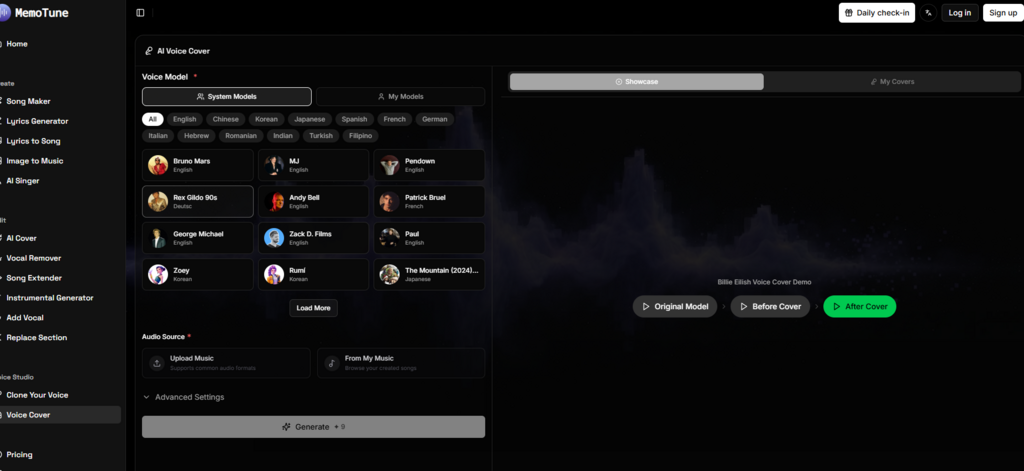
MemoTune’s broader platform includes tools for editing-oriented work, including section replacement, extending songs, and vocal or instrumental handling. The practical point is that users do not have to think of generation as a single irreversible step.
Iteration Makes The Tool More Believable
AI music becomes more useful when users expect revision. A stronger prompt, clearer lyric structure, or different style direction can produce a better fit. The platform is most helpful when treated as a creative loop, not a final-answer machine.
Where MemoTune Helps Different Creators
For lyric writers, the platform functions like a fast reality check. It can show whether a verse has momentum, whether a chorus feels memorable, or whether the emotional center of the song is clear enough. That does not make it a substitute for songwriting judgment, but it can accelerate revision.
For social video creators, the use case is more immediate. They often need music that matches a mood, visual rhythm, or short narrative. A creator can describe the scene and test whether a generated song supports the content. The result may still need selection and adjustment, but the workflow is much faster than building from silence.
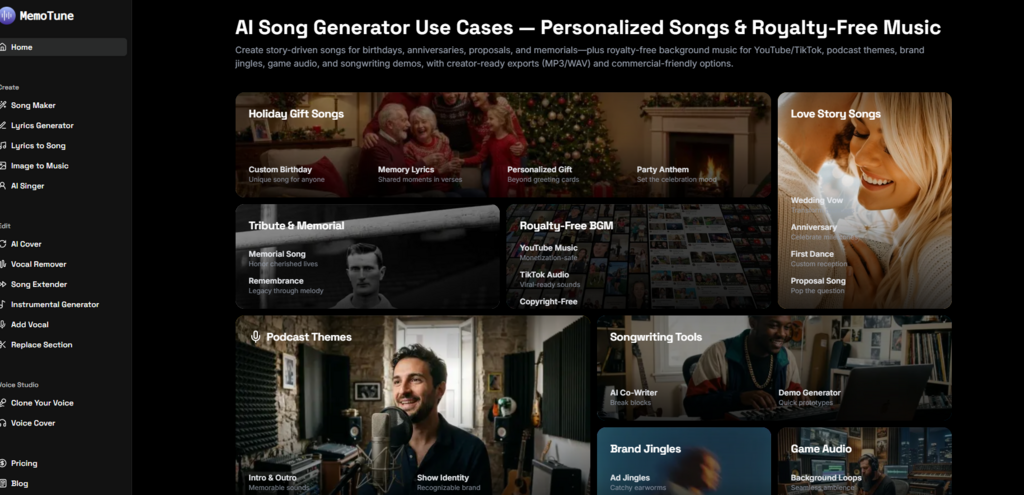
For small brands, MemoTune can be used to explore rough song concepts, jingles, intros, or background ideas. This is not the same as commissioning a final commercial track, and users should be careful with licensing terms. Still, as a concept-testing tool, it can help teams hear a direction before investing more effort.
The Most Natural Users Are Idea-First Creators
MemoTune feels strongest for people who know what they want to express but do not know how to turn it into music.
The Platform Bridges Emotion And Format
That bridge matters. A personal memory, product message, or creator concept is not automatically a song. MemoTune gives those ideas a musical form quickly enough for users to judge what works.
A Grounded Comparison For Creative Drafting
| Testing Area | MemoTune Song Workflow | Basic Prompt-Only Generator | Traditional Music Production |
| Best starting material | Lyrics, prompts, story ideas | Short text prompts | Compositions, recordings, sessions |
| User control | Guided mood and style choices | Often broad and unpredictable | Deep but technical |
| Learning curve | Beginner-friendly | Beginner-friendly | Usually steep |
| Drafting speed | Fast for song-shaped ideas | Fast but less directed | Slower and more manual |
| Revision mindset | Listen, adjust, regenerate, refine | Often regenerate broadly | Edit every detail manually |
| Best user type | Writers, creators, personal song makers | Casual experimenters | Producers and musicians |
This comparison shows MemoTune’s practical position. It is not competing with every professional production tool. It fits the earlier and messier stage where users are still trying to discover what their song should become.
What The Platform Does Not Magically Solve
The main limitation is that prompt quality still matters. If the user gives a shallow description, the song may feel generic. If the lyrics are too long, unclear, or structurally confusing, the result may need multiple attempts.
Another realistic limitation is consistency. AI-generated songs can vary, even when the same general idea is used. That can be helpful during exploration, but it also means users should expect to test more than one version when the emotional target is specific.
Taste is also impossible to automate completely. A song can be technically coherent but still not feel right to the person who wrote the story. The platform can generate structure, vocals, and musical direction, but the user still decides whether the result has the right emotional weight.
The Tool Works Best With Human Editing
MemoTune should be treated as a creative assistant rather than a guaranteed final producer.
Selection Is Part Of The Creative Skill
The user’s job is to listen critically. Keep the parts that match the intention, revise the prompt when the mood is wrong, and regenerate when the song needs a different emotional center.
Why This Angle Feels More Honest
The best way to understand MemoTune is not as a magic songwriting machine. It is more convincing as a practical bridge between text and music. That bridge is valuable because many people have ideas that never become songs simply because the production barrier is too high.
For personal use, it can turn a memory or message into something more emotional than plain text. For creators, it can turn a content brief into a musical draft. For lyric writers, it can expose what works and what needs rewriting.
That is a realistic role, and it is useful precisely because it does not pretend every output will be perfect. MemoTune gives users a faster way to hear their ideas, test their direction, and decide what to do next. In modern AI music creation, that may be the most practical advantage of all.